On this page
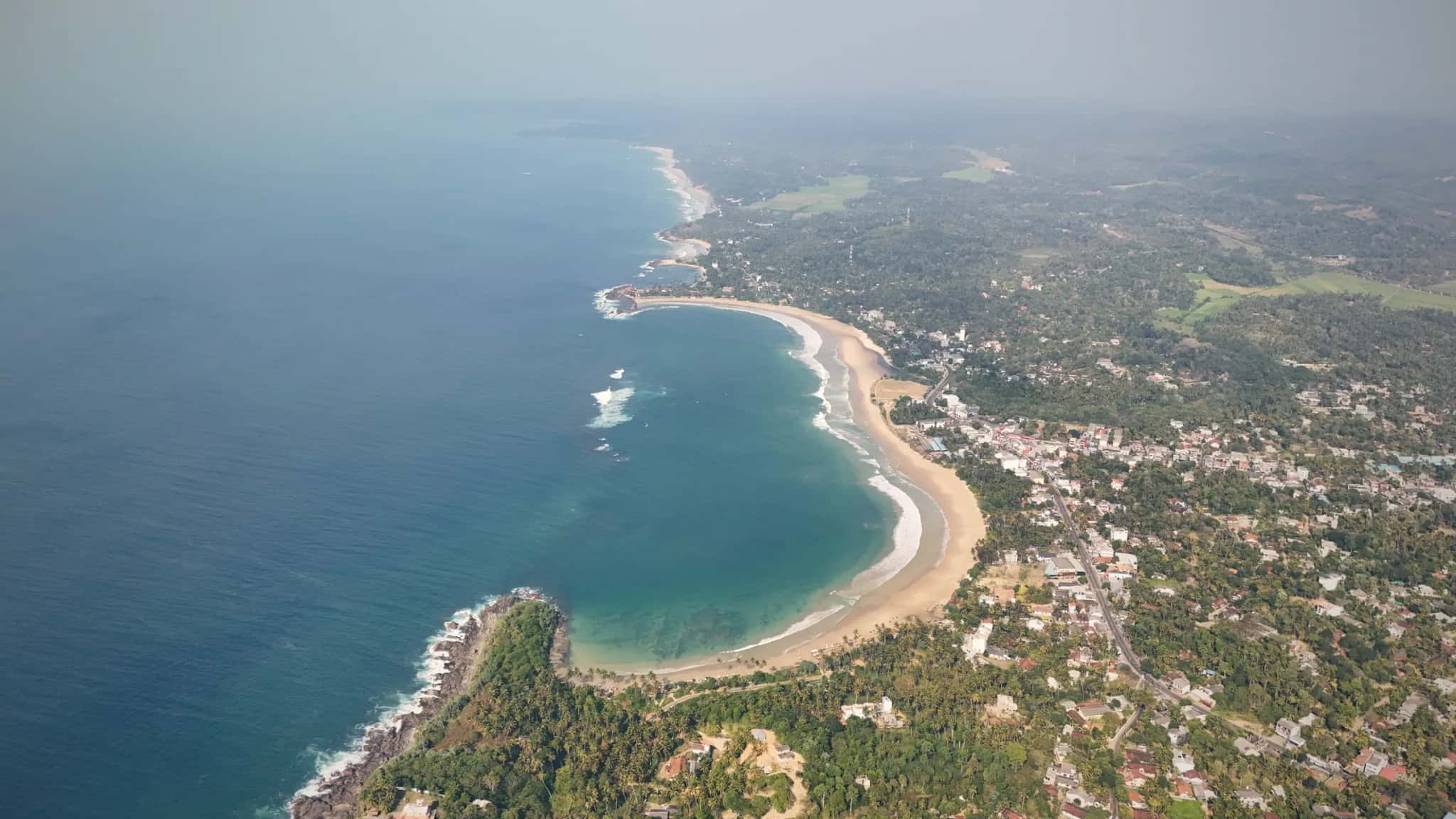
The south coast of Sri Lanka is a string of bays, palm trees, fishing ports and surf breaks. From the ground each one looks small. From the air you see how the beach, the reef and the road fit together.
This guide goes through the main places, when to film and what the rules mean on a beach.
Hiriketiya
Hiriketiya is a small horseshoe bay just outside Dickwella. Surfers use it, and it has cafes and surf schools around the sand. From above you see the curve of the beach, the reef and the surf breaks, which is what our own photo shows.
Mirissa
Mirissa is in Matara District. It is a fishing port and one of the main places on the island for whale and dolphin watching. A drone shows the harbour, the boats and the beach together. Whale season is usually put at November to April, and sightings are never guaranteed.
Weligama
Weligama is also in Matara District, about 144 km south of Colombo. Its name means sandy village, and its bay is a wide sandy sweep. The town is known for stilt fishermen, who stand on a single pole in chest deep water just off the beach, and for Taprobane Island, a small islet with a villa.
Galle and the fort
Galle Fort covers 52 hectares on a point of land, and it is a UNESCO World Heritage Site. It is one of the places that needs a special heritage approval for a drone flight. Read drone filming at Galle Fort.
What the rules mean on a beach
- Beaches are public places. The drone never flies over a crowd, and keeps a safe distance from swimmers, surfers and people who are not part of the shoot.
- Fishermen and boats work on this coast. Keep clear of them and of the lines they use.
- People who are filmed close up should know the drone is flying and agree to it.
- The pilot keeps the drone in sight, so we plan where the pilot stands before take off.
- Hotels and villas on the shore need to agree to a flight, usually with a short letter.
Check the exact spot on the CAASL drone zone map, because a hotel or a harbour can sit close to a restricted area. Our guide to drone no fly zones in Sri Lanka lists what to look for.
When to film the south coast
The south and west coasts get most of their rain from May to September, during the southwest monsoon. December to March is usually the drier stretch, and it overlaps the whale season. Surf on the south coast is usually best in the dry season too, from about November to April, so a shoot in that window often has surfers in the water.
Drones cannot fly in rain, gusty wind or thunder, and coastal wind can be strong. Our DJI Air 3 stays steady in wind up to 12 m/s. See the best time for drone filming for the table by region.
What people film here
Hotels and villas on the beach use drone video for their booking pages. Couples film a honeymoon on the sand, and surfers film a session from above. Read about hotel drone video and honeymoon drone video, or see our travel drone videography page.
Questions people ask
Can you fly a drone on a beach in Sri Lanka?
With approval, yes. Beaches are public places, so the drone keeps away from people and never flies over a crowd. Check the exact spot on the CAASL zone map first.
What is the best time for drone filming on the south coast?
December to March is usually drier on the south coast. The southwest monsoon brings most of the rain from May to September.
Can you film whales from a drone at Mirissa?
Sightings are never guaranteed, and the drone has to keep a safe distance from boats. The season is usually put at November to April. Ask us before you plan it.
Can you film surfers?
We can film surfers from a safe distance, at places where drones are allowed. Hiriketiya and Weligama are popular spots.